Accrual accounting records the financial effects of transactions and other events in the periods in which they occur—not simply when cash is received or paid.
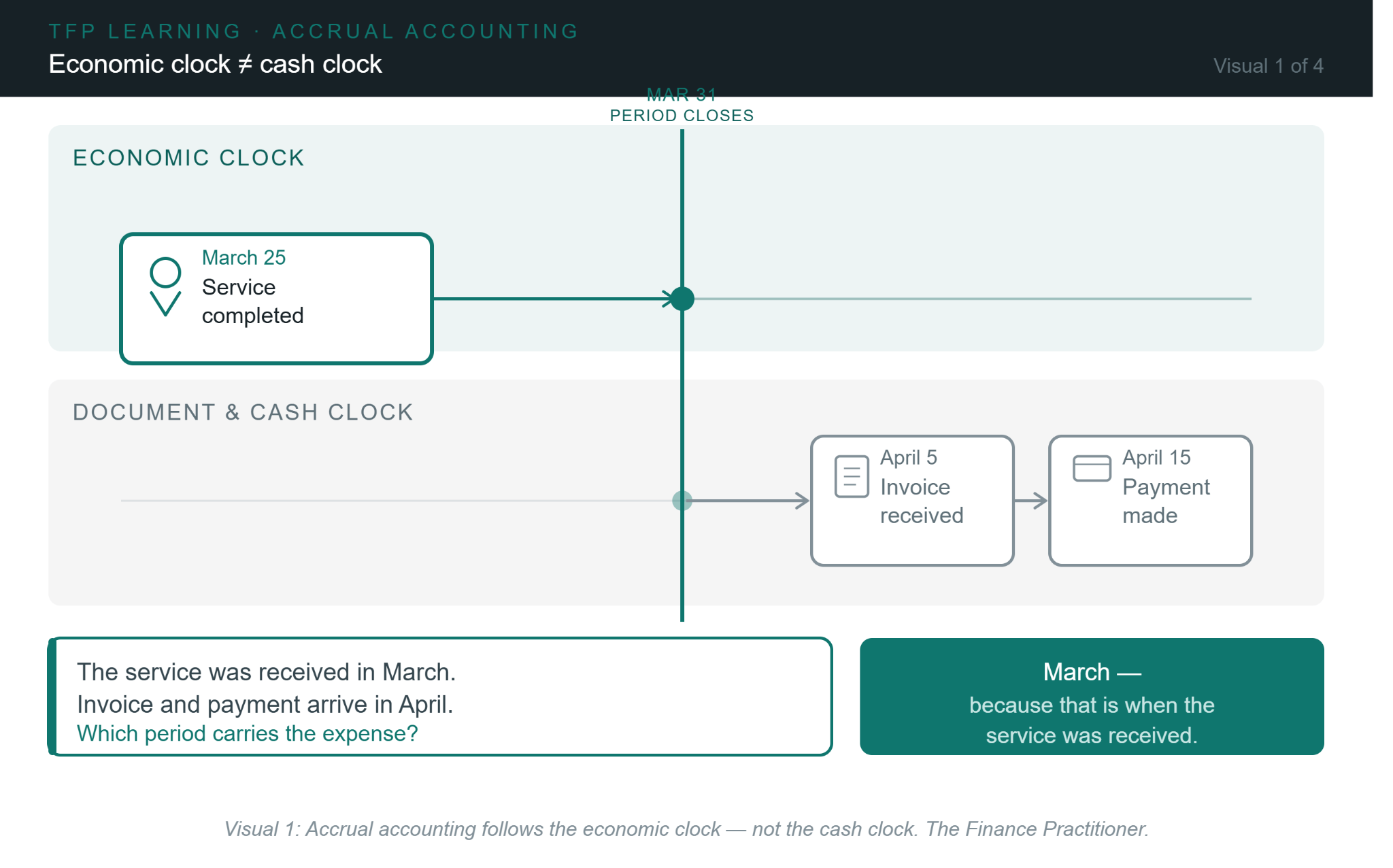
Economic clock ≠ Cash clock
Accrual accounting follows the economic activity—not merely the movement of cash.
What Is Accrual Accounting?
Accrual accounting recognizes the financial effects of economic activity in the period in which those effects occur, even when the related cash movement happens in another period.
Imagine that a business receives a service in March but pays for it in April. The service helped the business operate in March. Waiting until April to recognise the cost would make March look more profitable than it really was.
Accrual accounting solves this timing problem.
- The economic clock: When did the business actually receive or provide the economic benefit?
- The cash clock: When did the money move?
Those two clocks do not always point to the same reporting period. Accrual accounting follows the economic activity—not merely the movement of cash.
See the Timing Problem
Suppose a company engages a consultant to perform work during March.
- March 25: consulting service completed
- March 31: month-end reporting date
- April 5: supplier invoice received
- April 15: supplier paid
The company received the benefit of the consulting service in March, but both the invoice and payment arrive in April.
If the company waits for the invoice, the March accounts omit the consulting cost: expenses are understated, profit is overstated, and the obligation is missing.
Accrual accounting allows the company to recognise the economic reality before the invoice and cash catch up.
What Does “Incurred” Mean?
Incurred
An expense is incurred when the related benefit has already been received or consumed. The invoice or payment may happen later.
Examples include employees who have performed work, electricity already consumed, a consultant who has delivered a service, or goods that have been received and used.
An expense does not suddenly come into existence because an invoice arrives. And it does not wait for cash to be paid. The underlying economic event comes first.
Work It: Recording an Accrued Expense
Return to our consulting example. Assume the March consulting service is expected to cost $100,000.
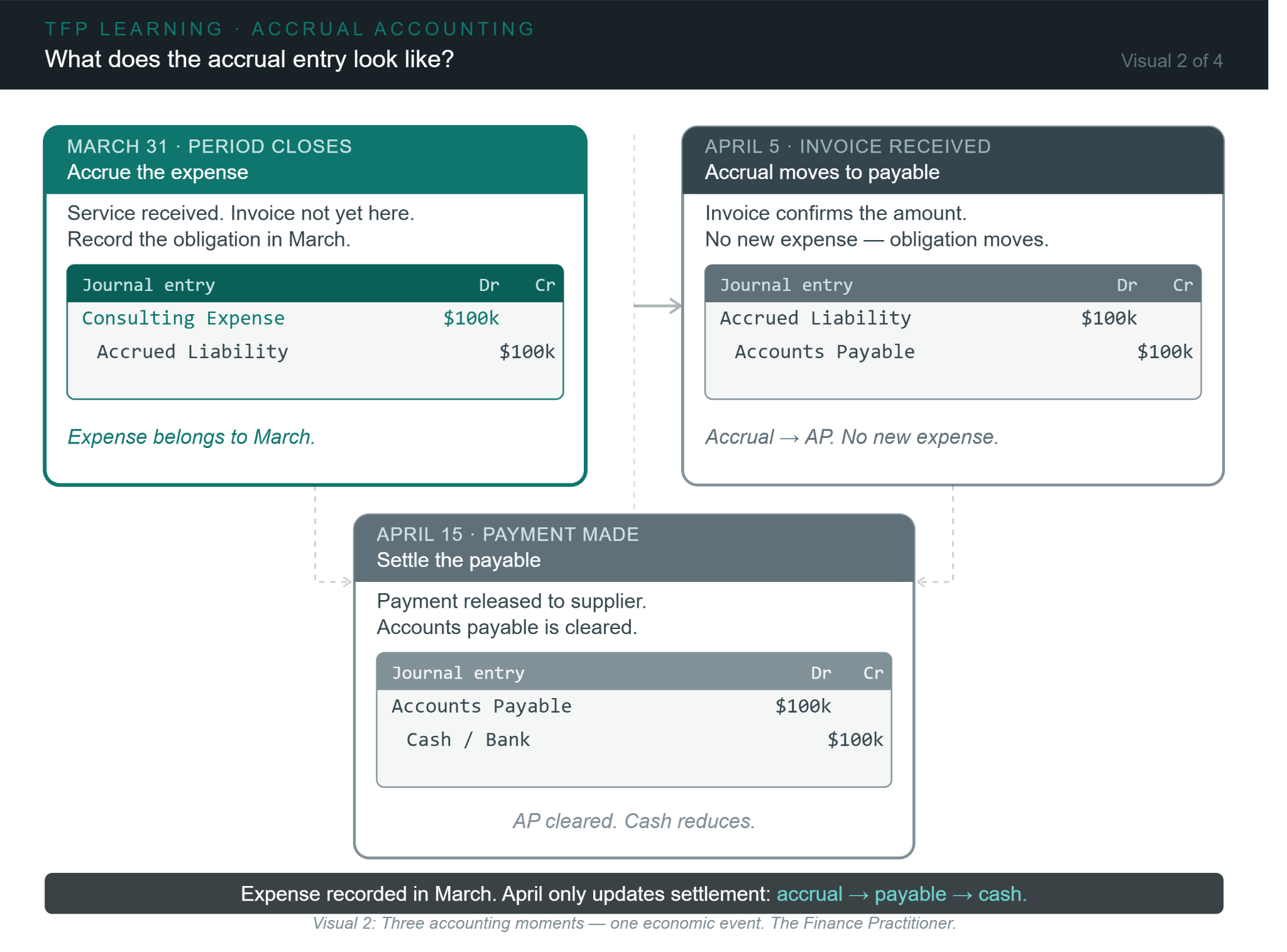
At March 31, the simplified accrual entry would be:
| Account | Debit | Credit |
|---|---|---|
| Consulting Expense | $100,000 | |
| Accrued Liability | $100,000 |
- Expense increases by $100,000 — The March income statement now includes the cost of the consulting service.
- Liability increases by $100,000 — The company records that it owes an amount for the service received.
- Cash does not change — Nothing has been paid yet.
An accrual can affect profit and liabilities without affecting cash.
What if the Exact Amount Is Not Known?
This is where real accounting becomes slightly messier than textbook examples. The supplier invoice may not have arrived by month-end, which means the final amount may not yet be known.
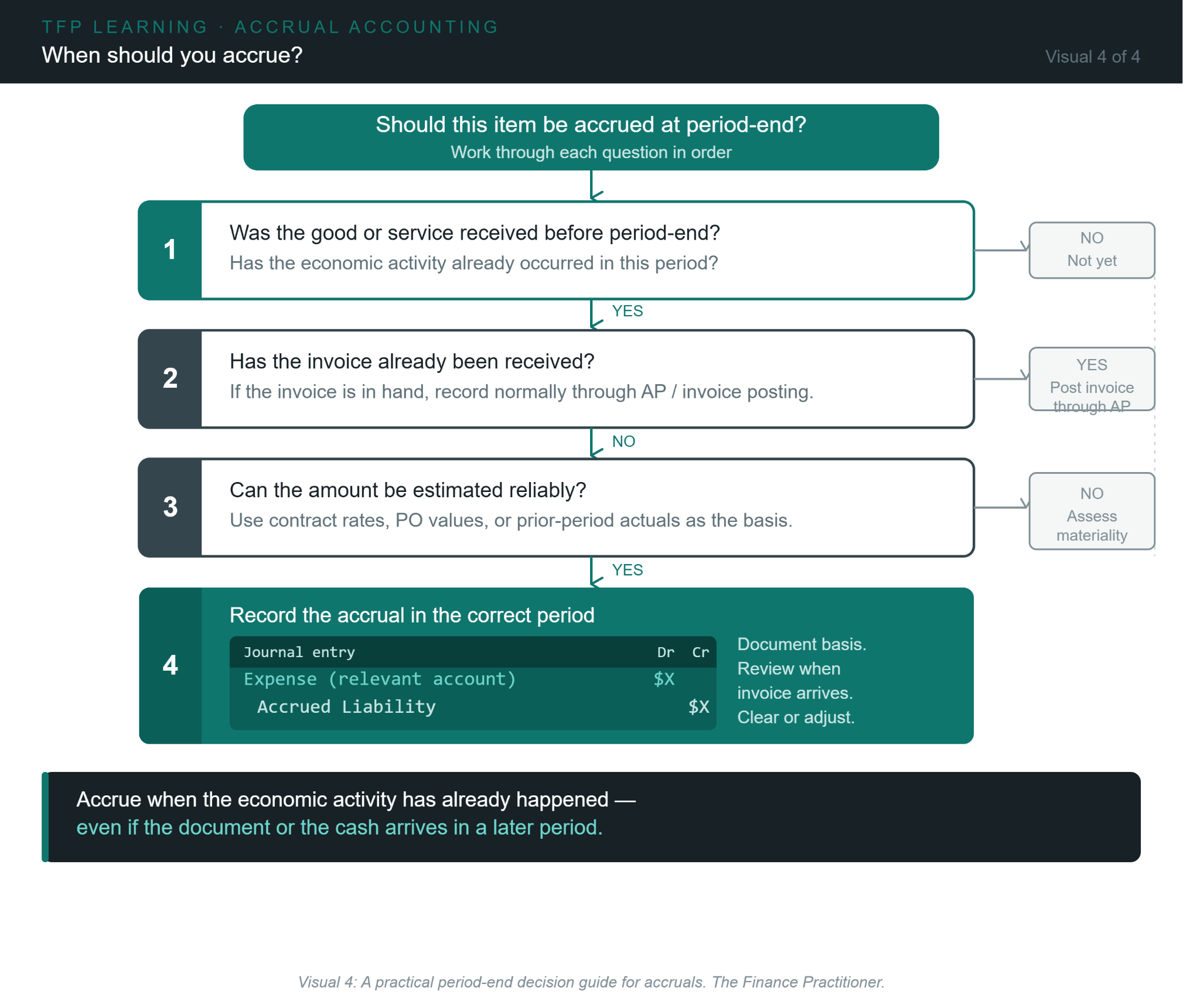
The accountant may therefore need to make a reasonable estimate using the best information available. Depending on the situation, that might include contract rates, purchase-order information, services completed, information from the business owner, supplier correspondence, and other supporting evidence.
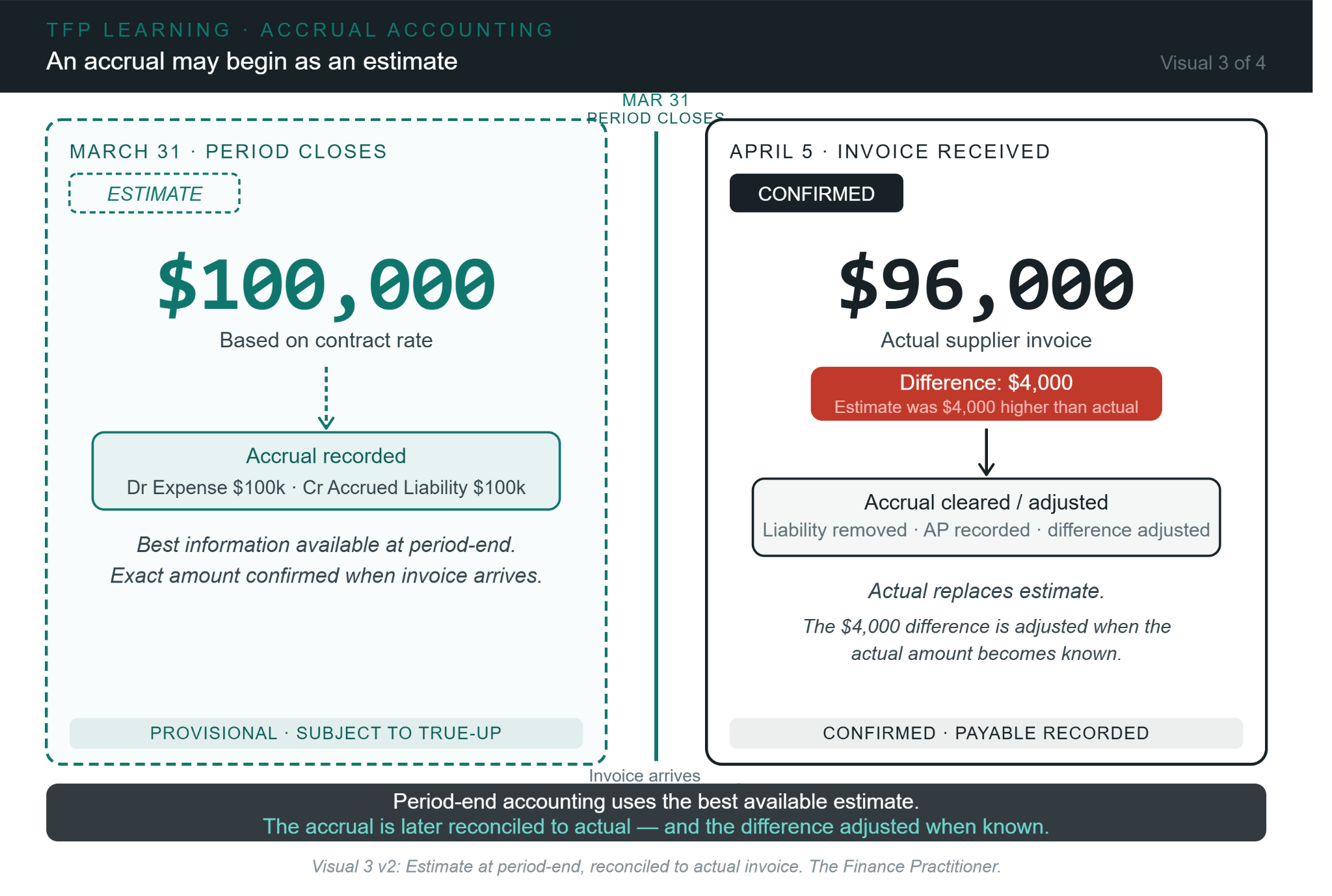
Suppose the company estimates the March consulting cost at $100,000.
Estimate at March 31: $100,000
Actual invoice: $96,000
Difference: $4,000
The estimate was therefore $4,000 higher than the actual amount. The accounting process needs to adjust the estimate to the actual invoice.
Accrual accounting does not always mean knowing the final number perfectly at period-end. An accrual may involve a reasonable estimate based on the information available at that time.
This is one reason accrual accounting involves judgement rather than simply processing invoices.
Watch: Accrual Accounting in About a Minute
Prefer a quick visual explanation? Watch our short explainer to see how the economic event, accrual entry, estimate-to-actual adjustment, invoice, payment, and period-end decision flow fit together.
What Happens When the Invoice Arrives?
Receiving the invoice in April does not mean that the March service suddenly becomes an April expense. March remains the period in which the service was received.
Instead, the accounting process needs to replace, clear or adjust the earlier accrual using the actual transaction—without recognising the same expense twice.
Different organisations and ERP systems handle the mechanics differently. Some reverse the accrual in the next period and record the invoice normally; others use a clearing or true-up process.
Those mechanics are important, but they are not what makes the accounting “accrual accounting.” The objective is to recognise the financial effect in the appropriate period and avoid recording it twice.
Accrual Accounting Works Both Ways
Accrual accounting is not only about expenses. Suppose a consulting company completes $50,000 of work in March but does not bill the customer until April. If the revenue-recognition requirements are met, the revenue may belong in March. The company may record accrued revenue before the invoice is issued.
The detailed revenue-recognition rules are a separate lesson. The important point here is that accrual accounting works on both sides: expenses and revenue.
Accrual vs Accounts Payable vs Prepayment
These ideas are related, but they are not the same. A useful way to distinguish them is to ask what happened first.
- Accrual: benefit received, invoice or accounting capture later, payment later.
- Accounts payable: benefit received, invoice recorded, payment still outstanding. If the invoice is already recorded, no additional accrual is needed for the same item.
- Prepayment: payment occurs first and the benefit comes later—for example, paying for 12 months of insurance before the coverage is consumed.
An obligation initially recorded through an accrual may later move into normal Accounts Payable once the invoice arrives and is processed.
Practitioner Lens: Accruals at Month-End
At month-end, accountants are often asking one simple question:
What did the business receive during this period that the accounting records have not captured yet?
Identify → Validate → Estimate → Document → Record → Compare with actual
Good accrual accounting therefore depends on more than journal-entry knowledge. It depends on communication with the business, evidence, disciplined estimates, clear documentation and follow-up when actual invoices arrive.
This is also where Accounts Payable quality matters: weak invoice visibility, late approvals and poor cut-off discipline make accurate accruals harder. See What Does a Healthy Accounts Payable Function Actually Look Like?
Accrual Is Not the Same as an Adjusting Entry
An adjusting entry is a broader category of period-end accounting entry. Accruals are one type of adjustment. Other adjustments can include prepayments, depreciation, and other estimates or allocations.
The terms are therefore related, but they are not synonyms. Adjusting entries deserve their own lesson.
Test Yourself
1. Employees worked the final five days of March, but the next payroll will be paid in April. What is the March treatment?
Record an accrued expense. The employees performed the work in March, so the related salary cost belongs in March.
2. A supplier’s March invoice was already received and recorded in Accounts Payable before close. Is another accrual needed?
No. Recording another accrual for the same item would duplicate the liability and expense.
3. A company pays for 12 months of insurance before the coverage begins. Is this an accrual or a prepayment?
It is a prepayment. Cash moved before the related benefit was consumed.
4. Consulting work was completed in March but billed in April. What may be required?
Accrued revenue may be required if the applicable revenue-recognition requirements are satisfied.
Key Takeaway
Accrual accounting follows economic activity—not merely cash movement.
When a business receives or provides economic value in one period while the related invoice or cash movement happens in another, accrual accounting helps keep the financial effects in the appropriate reporting period.
Economic clock ≠ Cash clock
Technical Note
Accrual accounting is not merely an informal accounting convention. FASB’s conceptual framework describes accrual accounting as recording financial effects in the periods in which the related transactions, events and circumstances occur instead of accounting only for cash receipts and outlays.
Under IFRS, the accrual-basis requirement historically contained in IAS 1 was moved into IAS 8 as part of the changes accompanying IFRS 18. IFRS 18 is effective for annual reporting periods beginning on or after 1 January 2027, with earlier application permitted.
A further nuance: matching may result from recognising related changes in assets and liabilities, but the IFRS Conceptual Framework does not treat matching costs with income as an objective in itself. That is why this lesson teaches accrual accounting through economic events, assets/liabilities and timing rather than reducing the concept to “the matching principle.”